Glock MOS vs standard: is the optic cut worth it?
MOS stands for Modular Optic System, Glock's name for a slide that comes from the factory with a pocket milled behind the ejection port and a set of adapter plates so a red dot can be mounted without a gunsmith. Almost every current model is offered both ways, and the MOS costs a little more. This guide explains what you get, what the plates do and do not do, which optics fit, and who should pay for the cut.
What is in the box
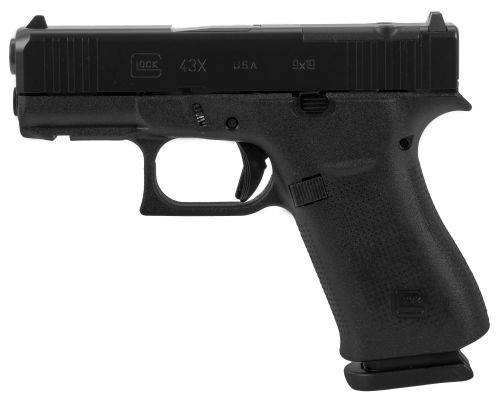
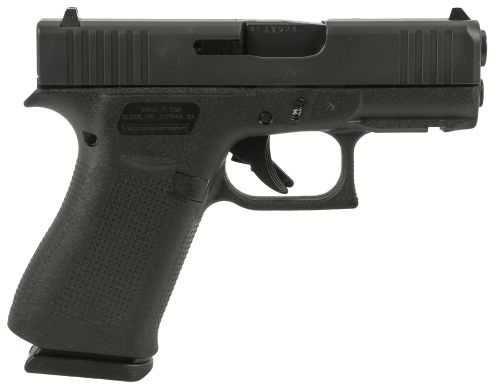
An MOS pistol ships with a cover plate installed over the pocket, so it shoots as a standard pistol until you mount a dot, plus a set of numbered adapter plates and screws. On Gen 4 and Gen 5 MOS pistols the plate set covers the common footprints: the Docter and Noblex pattern shared by Vortex and Meopta, the Trijicon RMR pattern shared by the Holosun 407C and 507C, the C-More pattern and the Leupold DeltaPoint pattern. You choose the plate for your optic, screw it to the slide, then screw the optic to the plate. The slimline 43X MOS and 48 MOS are different: they are cut directly for the Shield RMSc footprint with no plates, because the slide is too narrow for them.
The plate trade-off
A plate raises the optic a few millimeters above a direct mount and introduces a second set of screws that can loosen. Both are real and both are manageable: the extra height means suppressor-height iron sights are needed to co-witness, and the screws need a torque driver and blue thread locker. Enclosed-emitter optics and the heavier dots are harder on plate screws than small open dots. Some owners send an MOS slide out to be milled directly for one footprint anyway, which is allowed and common; the MOS cut simply gives them a starting pocket.
MOS versus milling a standard slide
Milling a standard slide for one optic sits the dot lowest and costs a gunsmith fee, a week or two without the slide, and a cut that fits one footprint for the life of the slide. MOS costs a little more at purchase, fits several footprints and needs no gunsmith. For a first red-dot pistol, MOS is the simpler path; for a competition pistol that will wear one specific dot forever, a direct mill is cleaner. An aftermarket slide already cut is the third route and leaves the factory slide untouched.
MOS versus iron sights
A red dot makes accurate shooting easier to learn, extends the distance at which most people can hit, and works in low light. It also needs a battery, a habit of finding the dot on the draw, and iron sights tall enough to use if it fails. If you will practice, a dot is better; if the pistol will sit in a safe and come out twice a year, iron sights are simpler. Buying the MOS version keeps the choice open: with the cover plate on, it is a standard pistol.
Which optics fit
- Gen 4 and Gen 5 MOS, standard frame: Trijicon RMR and SRO, Holosun 407C and 507C, Vortex Venom and Viper, Leupold DeltaPoint Pro, C-More and others through the plate set. Enclosed optics such as the Aimpoint ACRO need an aftermarket plate.
- 43X MOS and 48 MOS: RMSc-footprint optics: Holosun 407K and 507K, Shield RMSc, Trijicon RMRcc with its adapter, and others direct to the slide.
- Glock 40 MOS and 20 Gen 5 MOS: the standard plate set; hunters usually fit an RMR or a Holosun 507C.
Who should buy MOS
Anyone who expects to shoot with a red dot within a year: the cut costs less than milling later, and the pistol shoots as a standard one until then. Buyers over forty whose eyes no longer focus on a front sight, who will find the dot a revelation. Competitors in carry optics divisions. Hunters with a 10mm, for whom a dot at 50 yards is the whole point.
Who should skip it
Buyers who want the simplest possible pistol, who will not practice the draw with a dot, or who want the cheapest Glock in the model; the standard slide is a few dollars less and has no plate to worry about. Anyone in a roster state where the MOS version is not listed. Anyone buying a Gen 3, which has no MOS version except through the aftermarket.
Batteries and upkeep
A red dot adds one maintenance item: the battery. Most current optics run a year or more on a single cell and many have shake-awake or always-on modes; replace the battery on a calendar date, not when the dot dims, and keep a spare in the range bag. Wipe the lens with a soft cloth, check the screws with a torque driver every few hundred rounds, and confirm zero after any drop. An MOS pistol with a dead optic still has its suppressor-height irons, which is the reason to fit them.
Setting one up
Fit the plate for your optic with the supplied screws and blue thread locker, mount the optic with a torque driver to the optic maker's figure, fit suppressor-height sights, and zero at 10 yards then confirm at 25. Recheck the screws after the first hundred rounds. Replace the battery on a schedule, not when it dies. The 17 vs 19 vs 45 guide covers which model to cut, and the Gen 5 vs Gen 4 guide the generation. Browse Glock MOS pistols; they ship to a licensed dealer near you.
General information, not legal advice. Current as of September 2026. Laws change; check the official source before you act.